Chris Wood speaks at the Andrus Center conference on salmon in April 2019
The Idaho State Council of Trout Unlimited invites you to join Chris Wood, Trout Unlimited CEO, for a discussion on the path forward to remove the lower four Snake River dams and recover wild salmon and steelhead.This Boise event will be April 28th at 6:30 PM – at the Riverside Hotel on Chinden Blvd. in Garden City.
Our Idaho State Council meeting will follow on Friday April 29 at the Riverside Hotel.
The Snake River Basin provides more than 50 percent of the coldwater habitat available to Pacific salmon and steelhead in the Lower 48. But these critical waters are blocked by the four lower Snake River dams and fish populations are in rapid decline.
We have spent four decades and $17 billion trying to recover these iconic fish. It’s time that we rethink the future of the Northwest.
The Northwest deserves abundant and sustainable Snake River wild salmon and steelhead. We have a once-in-a-lifetime opportunity to ensure that future exists.
Posted inUncategorized|Comments Off on Trout Unlimited CEO Chris Wood in Boise April 28
The Coeur d’Alene Project Manager, Erin Plue, is excited for the upcoming restoration of Prichard Creek which feeds into the North Fork of the Coeur d’Alene River. This project is highly anticipated by local stakeholders and fisheries managers. This waterbody was the site of numerous hard rock mines, immense hydraulic mining, and an in-stream dredge that turned over five miles of the valley in the early 1900’s. Even with the destruction of this waterbody, westslope cutthroat trout still pile up at Prichard because of the cold water, but at about four miles up the stream they are blocked from reaching ten more miles of cold water refuge in the summer by subsurface flows due to the impact of the placer dredge mining.
Prichard Creek is currently owned by a private lumber company, Idaho Forest Group (IFG), who is putting about 10.5 miles of the 14-mile stream into a conservation easement. Funding for the investigations, planning, and construction is coming from a local fund comprised of mining settlement money and managed by the Restoration Partnership, with the Idaho Department of Environmental Quality serving as the fiscal sponsor for the project. Trout Unlimited is managing the project with significant involvement from IFG.
The first phase of the project is underway with multiple consultants currently studying the geomorphology, biology, cultural history of the project area. Currently a multi-phased restoration plan is being developed and design for the first phase of construction is almost complete. The first phase of construction entails four sections of the bottom four miles of stream. Implementation of Phase 1 construction will begin the summer of 2022 and aims to be completed in 2023.
Posted inUncategorized|Comments Off on Turning a River Right – Prichard Creek
Check out this video of Laura Ziemer summarizing the many things in the Infrastructure Investment and Jobs Act that will be good for trout, salmon and watersheds. Her presentation starts at about eleven minutes into the video and it should be cued up at that point.
Posted inUncategorized|Comments Off on How the Infrastructure Bill is good for Trout
Trout Unlimited lies deep in the fishing culture throughout the United States. We are one of many organizations that’s mission involves bettering the streams and rivers of America. Every day, we work with partners from our hometowns, from across the country, and throughout the state. The American Fisheries Society (AFS) is a non-profit organization whose mission is to improve the conservation and sustainability of fishery resources and aquatic ecosystems by advancing fisheries and aquatic science and promoting the development of fisheries professionals.
Within our amazing conservation staff at Trout Unlimited, we have truly knowledgeable, dedicated, and passionate people who are committed to their home waters. Matthew Green is among one of these TU staffers; Matt was honored by The American Fisheries Society, Idaho Chapter with the 2022 Aquatic Habitat Award earlier this month (March 2022). The Aquatic Habitat Award strives to recognize significant or innovative work performed by AFS members. The project, which recognizes involvement, commitment, and collaboration from the landowner of Beyeler Ranch, Trout Unlimited, Lost River Fish Ecology LLC, Bureau of Reclamation, Pacific Coastal Salmon Recovery Fund, Upper Salmon Basin Watershed Program, and The Governer’s Office of Species Conservation was completed in late 2021. To me, it says a lot that one of our partners in restoration in the Upper Salmon River Basin nominated Matt for this award. Together, we get great work done that improves our rivers and streams.
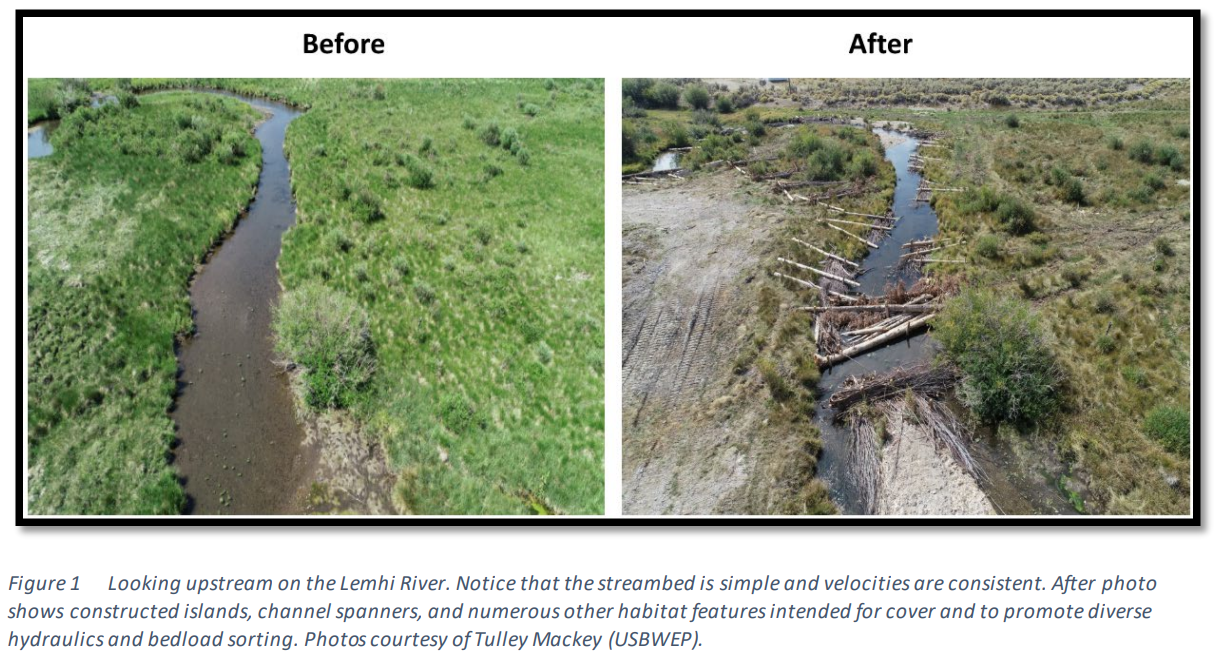
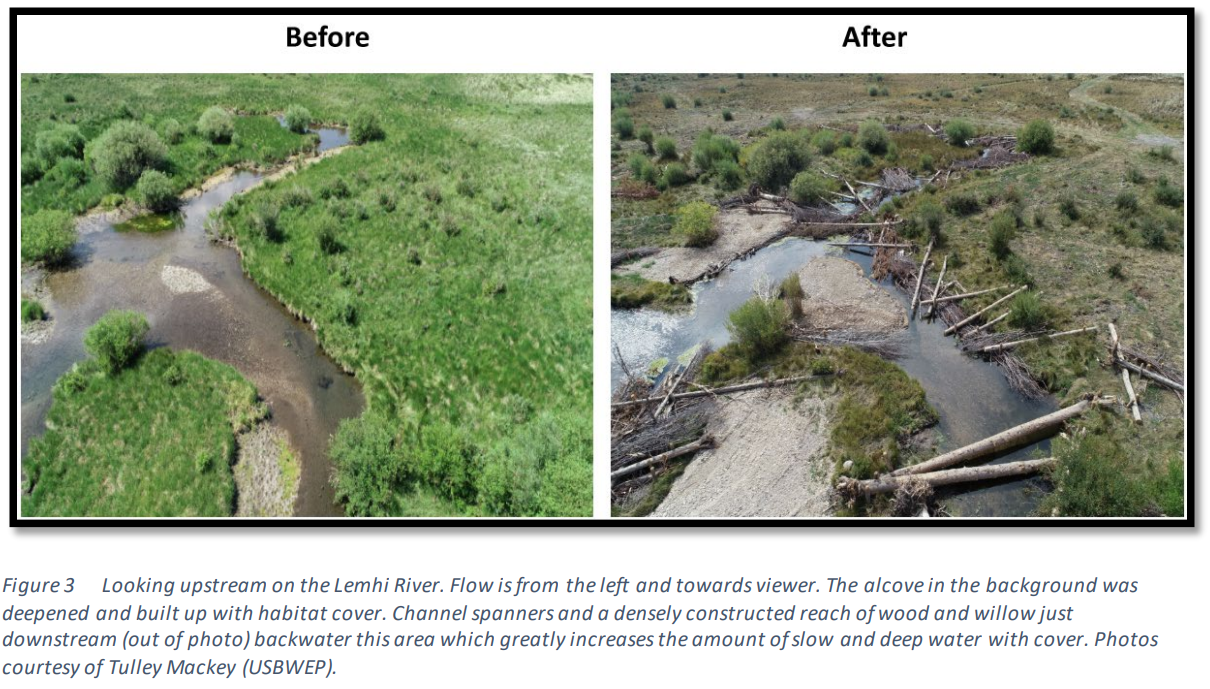
During the project, the teams worked together to ensure habitat complexity and abundance, floodplain connectivity, and improvement of riparian conditions for spring chinook salmon on private property owned and operated as a working cattle ranch by Beyeler Ranch in the Upper Lemhi Valley of Central Idaho. The project is one of many completed on this ranch over the last twelve years. The landowner has a history of salmon restoration which began with constructing a conservation easement with The Nature Conservancy back in 2010. This particular project covers a 3,800-foot stretch of river that had an oversized channel, with little cover habitat. The streams pace was too consistent for positive fish habitat prior to completion of the project, with too few pools and riffles.
One of the greatest challenges in this project was to complete the work without disrupting any existing spawning. The landowner also challenged the designer to complete designs that were minimally invasive. To the designers, this meant developing new wood and willow-based structures with little to no excavation required, as well as structures that helped develop forms and processes with chutes, pools, water backed up into floodplains, and riffles as would be expected when beavers (one of the main disturbances and, therefore habitat creators) were present. This project was the ultimate design of promoting natural channel processes and habitat development while challenging the implementation.
Ultimately, twelve habitat specific treatments were designed and built including a large meander structure made of an assortment of log sizes and willow clumps that required no excavation. Another innovative structure was a “deflector” made to mimic an old, densely rooted willow clump with substantial erosion resistance. When used across from one another, they develop a chute that scours the bed and sorts the sediments in riffle crests suitable for spawning. Channel spanning wood jams were used to back water up and scour beneath them to re-deposit sediments immediately downstream for spawning grounds. The backwater from enhanced areas of channel spanners also helped form loosely stage-zero-like areas with low velocities and dense cover.
In the end, the project blends well into the natural landscape of the ranch. We cannot wait to watch this develop into more complex habitat over the next few years. Congratulations to Matthew Green and the team of sponsors and supporters for your hard work and dedication to Idaho’s waters.
Posted inUncategorized|Comments Off on Matt Green Awarded Aquatic Habitat Award
Written by Matt Green-Trout Unlimited-Idaho Water and Habitat Program Upper Salmon Project Manager
Jerry Myers is a former Trout Unlimited project manager that lives along Indian Creek, a tributary to the Salmon River. Located in the remote Salmon River Mountains of Central Idaho, every spring as the small stream swells with runoff, he and his family observe wild steelhead spawning. Most years, they find several redds and get to watch as the fish build their nests and lay their eggs in the pristine, cold waters that Indian Creek provides. Later that year as their offspring hatched and moved downstream, Jerry observed something that he knew to be problematic. The fish were in an irrigation ditch that would be turned off as soon as the irrigation season ended, stranding those fish, and ending their seaward journey far too soon. Jerry describes, “Arguably, Indian Creek on the Salmon River is one of the toughest drainages in Idaho to support irrigated pastures. It’s steep, it’s confined in a narrow canyon and until recently, seven ditch diversions totally de-watered the stream…” The ditch irrigates several small pastures for downstream landowners. Jerry adds, “100-year-old practices had to change.” Indian Creek not only provides ideal habitat for steelhead but also has populations of juvenile Chinook Salmon, Bull Trout and Westslope Cutthroat Trout. As temperatures increase in the Salmon River during the summer months the cold waters of Indian Creek provide a refuge for native fish.
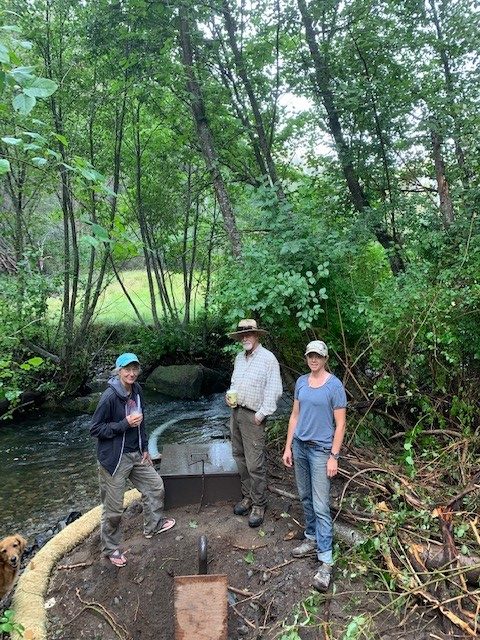
The agreement to work together and share a common fish screened diversion – took 2 decades – but now serves the community far into the future.
Over several years, Jerry and I were able to convince many landowners into partnering in an irrigation project that would help eliminate fish entrainment in their ditch systems. The timing had to be just right as all landowners had to be onboard with the concept in order for it to be successful. “The agreement to work together and share a common fish screened diversion took two decades,” Jerry says, “That is the reality of working in western watersheds, it takes time as well as an understanding of the local challenges. Trout Unlimited was here for the long haul.”
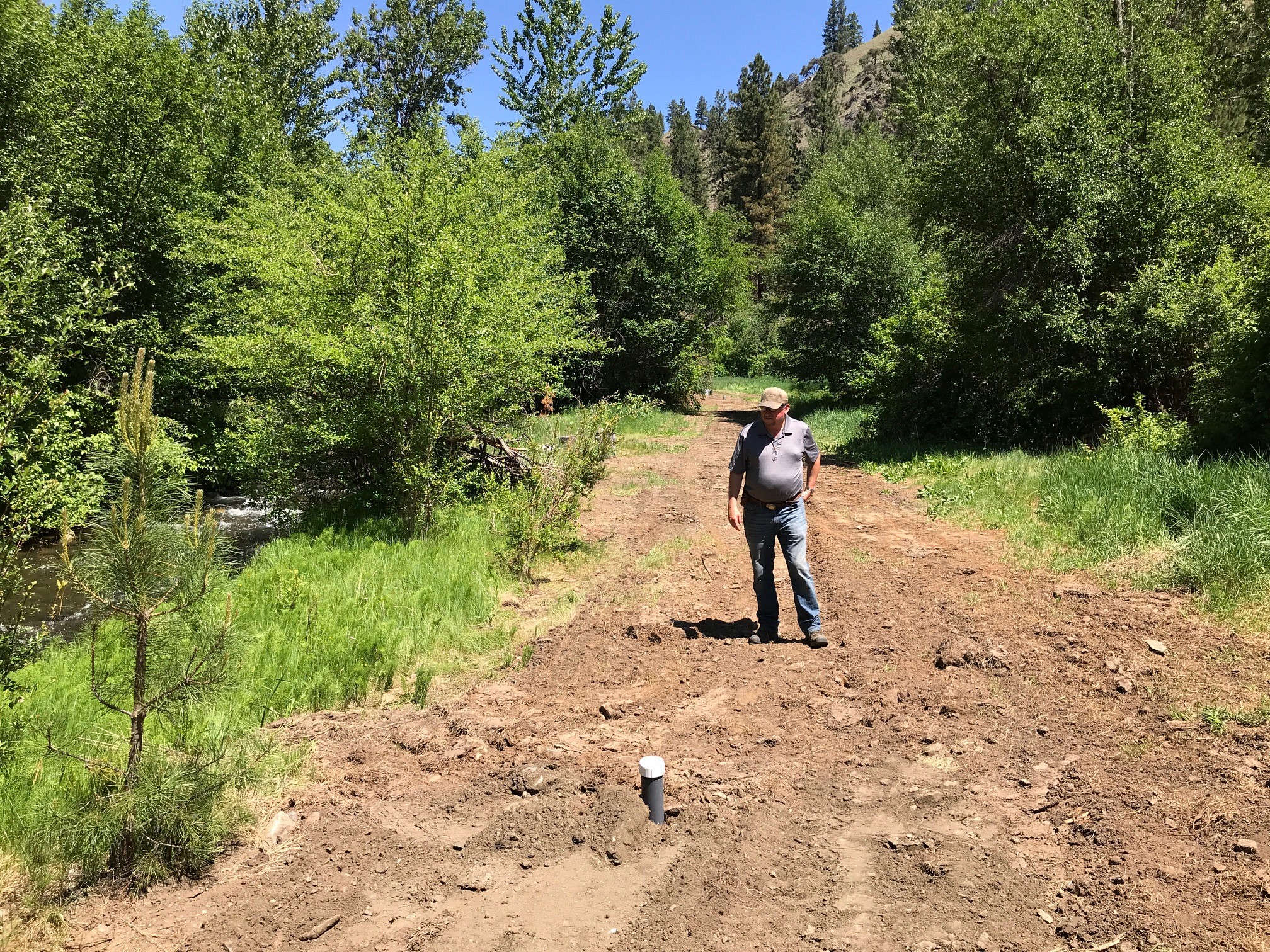
In the spring of 2021, after several years of landowner negotiations, funding requests (Pacific Coast Salmon Recovery Funds, U.S. Fish and Wildlife funding, and landowner match), permit applications, and designs (Natural Resource Conservation Services), we were finally able to implement the project. This included a fish screen provided by Idaho Department of Fish and Game and a new buried irrigation pipeline that provided gravity fed irrigation for all the landowners.
Completed System – 2021
Not only does this new system keep fish from entering the irrigation system and dying, but it also gives the landowners a low maintenance, efficient irrigation system that can double as a way to fight ever increasing forest fire threats -a true win-win for all involved. Jerry says it takes, “Patience, perseverance, collaboration and an organization willing to take the lead.” Along with help from landowners and partners mentioned above, the Upper Salmon Basin Watershed Program provided instrumental assistance with design review and permitting for this project. We are excited to finally see the completion of this project in our home waters.
The new system is an efficient, gravity pressurized irrigation system servicing six landowners
Posted inUncategorized|Comments Off on Indian Creek Irrigation Project
The deadline to apply for the Idaho State Council of Trout Unlimited graduate school scholarship is March 15, 2022.
Information on the scholarship is on our education page at https://tuidaho.org/education/ with a link to the application form from that page.
Students who are (or become) members of an Idaho Chapter of Trout Unlimited and enrolled at the graduate level at an Idaho university, researching native or endemic coldwater fish, or a related field are encouraged to apply.
Posted inUncategorized|Comments Off on The 2022 Idaho Trout Unlimited Scholarship
Trout Unlimited has established this paid internship program for a college students to learn about, contribute to, and participate in many aspects of Trout Unlimited’ s priorities, programs and projects in Idaho. Trout Unlimited’ s goal is to provide work experience to a college student who is interested in learning about various career opportunities and activities of a national non-profit conservation organization. The intern will receive a stipend of $4,500.00 for 8 weeks work.
The opportunity is hybrid, but the intern must be located within the Treasure Valley during the time of their work.
The Yankee Fork of the Salmon River, located northeast of the town of Stanley, has been highly impacted by legacy mining and timber harvest activities. Cassi Wood, TU’s Central Idaho Project Manager, in coordination with several partners, has been implementing the Bonanza City Stream & Floodplain Restoration Project each summer since 2018, with final major construction completed in 2020.
The Dredge is now a historic part of Idaho’s history
The 0.83 mile section of river and floodplain was repaired from the damage caused by the historic dredge-mining conducted in the early 1950’s. Reconstructing the river included removal of more than 100,000 cubic yards of dredge tailings that confined the river to a flume-like channel. Then, new sections of river channel were built, in addition to rehabilitating existing sections of river. The final goals and objectives for the finished project are for the river to have a level of sinuosity and complexity that more closely resembles the historic conditions that the Yankee Fork chinook salmon and steelhead populations evolved to thrive in. In October, Cassi was delighted to observe adult Chinook salmon near the project site.
This year, revegetation of the project area’s riparian areas, uplands, and floodplains is being completed. Monitoring of the project will occur over the next several years while the newly constructed river channel begins to seal and fish populations adjust to the new conditions.
The Bonanza Project 2021 – You can spot The Dredge at the top of the road – to the left
Posted inUncategorized|Comments Off on Turning a River Right Side Up to Help Salmon, Steelhead, and Trout – The Yankee Fork
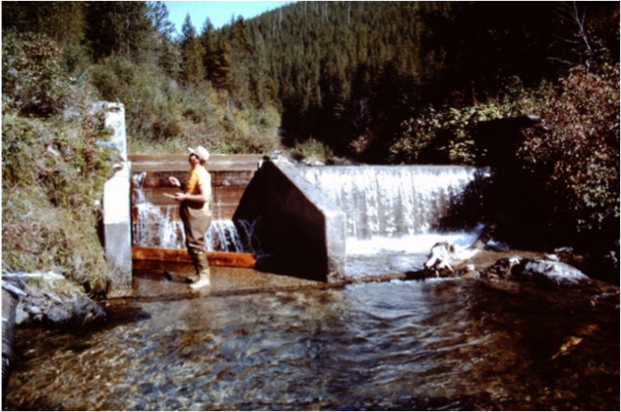
Removal of the Red Ives Dam has been anticipated for over 20 years! And the dam wasn’t giving up easy even when it came down to its final days. A fire had compromised the major access road to the forest, and it was headed in the direction of the major other access road. This situation led the Forest to close the area in which the dam was located to public access and management of the area was temporally handed over to a Type 1 fire team. Getting permission into the site seemed unlikely, but it was thankfully granted to the team and the weather cooperated to allow for removal of the Red Ives Dam.
Trout Unlimited partnered with the St. Joe Rangers Station of the Idaho Panhandle National Forest to remove the Red Ives Dam this August using funds supplied by the US Fish and Wildlife Service, the US Forest Service, Idaho Conservation League, Resources Legacy Fund, and the Coeur d’Alene Basin Restoration Partnership. The Red Ives Dam was built in the 1930s to provide power to the nearby ranger station until the mid 1980s. This project was the first project to hit the ground as a partnership between the Idaho Panhandle National Forest and Trout Unlimited.
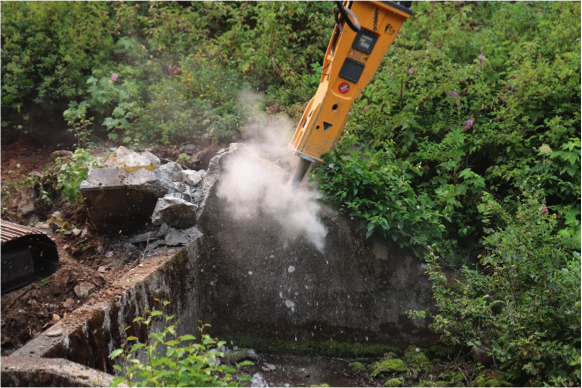
The hammering begins!
Even though the fire was compromising the access into the forest, the project area was not in immediate threat and the skies were clearer and the temperatures cooler than anywhere outside the Forest. Between the remote forest setting with none of the typical August crowds and the lack of traffic to manage, the project setting was idyllic. Our only visitors were the local marten, beavers, and the occasional firefighter completing their rounds.
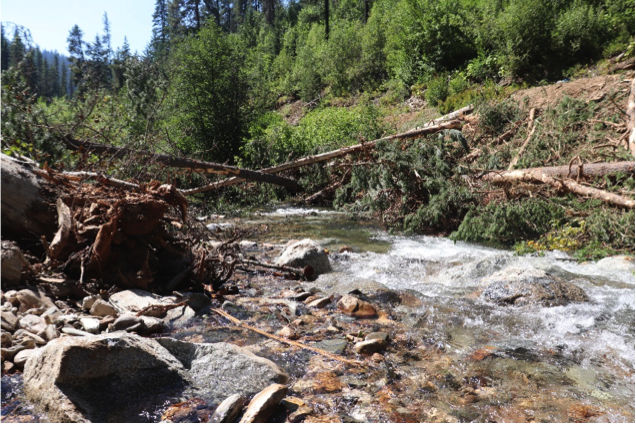
Looking down at where the dam once stood.
The dam proved to be of hardy construction representative of the times it was built. Far more concrete and rebar than the partners anticipated, but once the contractors solidified their method for hammering, the Red Ives Dam days were quickly done. Once all remnants of the dam were removed, the channel was regraded with a couple pools and a debris jam to provide cover for the native westslope cutthroat and bull trout. Red Ives Creek is one of the last remaining streams in which bull trout spawn, removal of the dam has opened the pathway to more habitat for the fish and for future phases of restoration on the waterway.
Posted inUncategorized|Comments Off on Removing the Red Ives Dam by Fire