
Luke Anderson, one of two scholarship winners from Idaho Trout Unlimited, will continue his studies at the University of Idaho, 2026-27. His essay below, submitted as part of his application for the Idaho State Council Trout Unlimited Graduate Scholarship, details his studies of Northern Pike in Lake Pend Oreille. – Ed.
Northern Esox lucius are a predatory fish that has been introduced widely outside of its native range. Northern Pike first appeared in the Lake Pend Oreille, Idaho system in the 1970s, believed to have spread downstream from Flathead Lake, Montana through the Flathead and Clark Fork rivers. Northern Pike abundances remained low until around 2017 when catch rates began to increase exponentially in Idaho Depart of Fish and Game (IDFG) nets. Given that Northern Pike will preferentially consume soft-rayed fishes, e.g., salmonids and cyprinids, managers are concerned may have a negative effect on native species, particularly Westslope Cutthroat Trout (Oncorhynchus lewisi) and Bull Trout (Salvelinus confluentus). My research looks to describe diets and population dynamics and assess their influence on native species and the existing fish assemblage in Lake Pend Oreille.
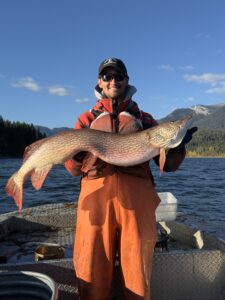
Luke Anderson with a Northern Pike from Lake Pend Oreille.
My research project is directly applicable to my fisheries career in several ways. First, I am gaining experience working on a type of waterbody on which I previously had not worked, i.e., large lake system. Prior to graduate school, much of my fisheries work was in river and stream systems working with anadromous and migratory salmonids. The work associated with my research allows me to diversify my fisheries knowledge and experiences. Second, the data management and analysis I am conducting with my collected data is reflective of analyses frequently done by fisheries biologists. Examples of these include describing age and growth patterns, estimating mortality, exploitation, and recruitment, and modeling ecological interactions.
Last, and most importantly, I am gaining valuable experience in communication. Fisheries biologists need to be able to communicate their data and results effectively, both to other fisheries professionals as well as members of the public. Since the inception of the project, I have discussed various aspects of my project with many members of IDFG and academia, often needing to effectively describe important nuances of the project. Similarly, I am frequently approached by anglers and members of the public at the boat ramp or on the water while sampling. While topics of discussion with the public are similar to those with biologists, the communication styles generally differ as the levels of background understanding and personal values can be significantly different. A fisheries professional needs to be able to effectively communicate with both demographics as the inputs and values from the anglers are equally important to consider when managing the resource.
This scholarship would help me achieve my career goals by assisting in funding travel to professional conferences. As I stated earlier, effective communication is a vital skill to have in this profession, and I would be able to further improve on it at conferences. Many of the people I discuss my hypotheses and results with are familiar with the Lake Pend Oreille system and already have a background understanding of the various components I am researching. By presenting at a conference and discussing my research with outside people with little to no background knowledge of the system, I can further practice my scientific communication skills. Additionally, I will be able to learn about novel ideas and techniques not used in the region, further diversifying my fisheries knowledge with concepts I can apply throughout my fisheries career.
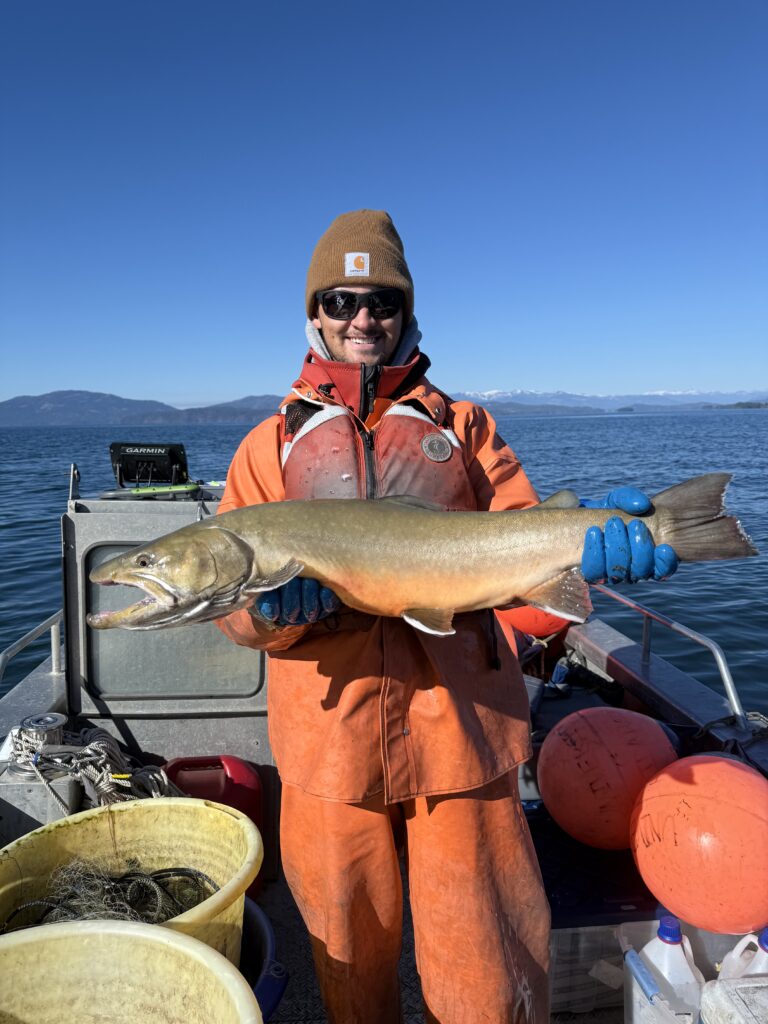
This native bull trout measures 27″ and was released unharmed back in to Lake Pend Oreille.