
Noah Frost, a current graduate student at the University of Idaho researching Yellowstone Cutthroat Trout in Idaho’s Blackfoot River, is one of our new recipients of the Idaho State Tour Unlimited Scholarship. The Idaho Council of TU’s scholarship was awarded this spring and will assist with Noah’s continued study in the 2025-26 academic year.
“I have been fortunate to know what I want to do with my career since a young age and my experiences thus far have only solidified these goals,” wrote Frost. “I knew I would need to get a Masters degree to become a fisheries biologist for a state agency.
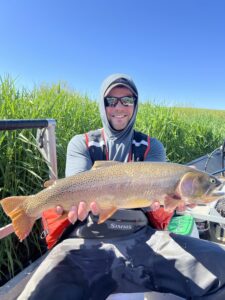
Noah Frost with one of the denizens of Idaho’s Blackfoot River.
Frost received his undergraduate degree from the University of Maine and moved to Idaho to continue gaining experience in the fisheries field. “Obtaining a Masters degree in a program that is so intertwined with native fish management and working collaboratively with state agencies would give me the best chance of continuing in the field and making a difference in native fish conservation,” said Frost. “Upon completing my degree at the University of Idaho, I will have the skillset and qualifications to work for a state agency such as the Idaho Department of Fish and Game and continue their mission to conserve and manage fish and wildlife resources in perpetuity.”
Frost began his fisheries career in 2016, working a seasonal job for the Maine Department of Inland Fisheries and Wildlife in the northern region of Maine. After several years he landed a permanent technician job in Salmon, Idaho, with the Idaho Department of Fish and Game. Starting in the summer of 2023, spending the next year and a half managing a crew of seven fisheries technicians conducting snorkeling and rotary screw trap work across central Idaho. “Collecting, analyzing, and conveying fisheries data throughout Maine and Idaho proved to me that quality research can make a difference in this field.”
Frost’s essay submitted with his scholarship application is reprinted below.
I will receive additional hands-on fisheries experience and learn important analytical techniques over the course of this two-and-a-half-year project. I will illustrate my ability to work independently, think critically, and communicate my findings effectively. These skills will allow me to apply and compete for fisheries biologist positions with natural resource agencies. Dr. Michael Quist’s lab is well known for producing quality, applied research on native fishes. There is an information gap regarding the Yellowstone Cutthroat Trout population in the upper Blackfoot River. I am conducting a hands-on investigation into what is driving population demographics in this system. I will spend months in the field, likely handle thousands of fish, and maintain remote PIT tag arrays. This work will yield a large amount of information that is not currently available to managers. My research project on this population will allow natural resource managers to make informed conservation decisions regarding the persistence of this population. Furthermore, my findings will be applicable to populations of Cutthroat Trout that inhabit mainstem rivers, lakes, reservoirs, and headwater streams.
I have built meaningful relationships with biologists and managers throughout my time as a technician. The next step to attaining my lifelong goal of becoming a fisheries biologist is completing this Masters program. The financial support from scholarships such as this one will be instrumental in helping me reach this goal for many reasons. Conducting fisheries research is expensive, and my project is roughly ten hours from my home. Additional financial support will allow me to purchase previously unbudgeted supplies (i.e., additional PIT tags, field groceries) and travel to and from my field station to manage remote PIT tag arrays in the shoulder seasons. I am not able to work a second job during this project, and support from conservation organizations like TU will ensure that the final product of this research is of top quality. Ultimately leading to meaningful conservation implementation and compounding benefits to Cutthroat Trout generally. Again, I thank you for your consideration and look forward to hearing back.
Noah Frost