
By Shawn Hills
When I first got the TU/NPT internship; I was ecstatic that I would finally be able to go out and help with conservation efforts. Although I have been fortunate enough to grow up in the gateway to Hells Canyon enjoy its many perks, I have never truly understood what conservation looks like.
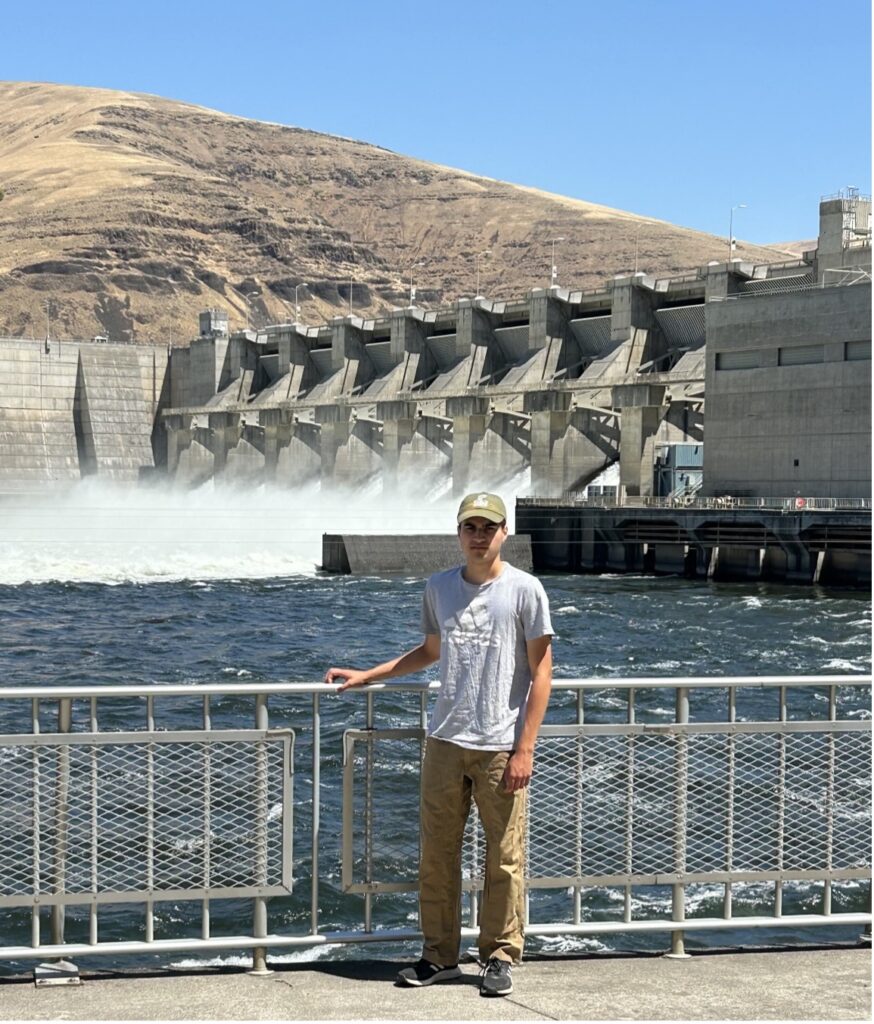
Shawn in front of Lower Granite Dam during a July Tour
First outdoor experience
Pilot Knob from neighboring hill
The second week was one of the most memorable times of my whole experience. During that time, I did barrier crossing assessments with Trout Unlimited (TU) on the South Fork Clearwater River. While surveying barriers, I learned that non-fish bearing streams are still vital because they can provide cold and clean water from high up on the mountains. Furthermore, failing culverts can block aquatic species movement and if the fail can lead to roads collapsing which can send a pile of dirt and debris into the sensitive aquatic ecosystems that fish like trout and juvenile salmon rely on. During our work we got to see a ton of breathtaking wilderness that I hadn’t seen before. After this trip I was super excited about what work lay ahead for the rest of the summer.
Working with Trout Unlimited
Although much of my work was with the Nez Perce Tribe or on TU/NPT partnership projects, my direct work with TU was impactful. With TU I was able to observe the construction of a new stream, survey a sediment sump dump, interview TU workers from different areas, and got to see Lower Granite Dam.
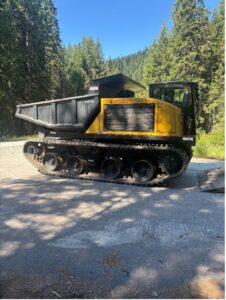
Track truck at Indian Grave Creek site
On Indian Grave Creek there was a velocity constraint from the steepness and straightness of the channel. So, in partnership between TU, the Nez Perce Tribe, and a contractor they were able to go in and form a new channel that would allow easier fish passage. I also learned about the techniques used to form new channels like strategically placed logs, rocks, and dirt. I also, learned what factors are worthy of consideration when doing restoration work, like determining the goal of the new stream after restoration, and that it is important to evaluate nearby landscape to determine if there was a historical channel. Along with at I got to see some cool machinery at work.
I got to interview TU staff in different departments and places outside Lewiston. One of them is Helen Neville, who is a senior scientist, and she taught me about genetics and how they can play an important role in conservation. I also got to interview Paul Parsons who is the restoration director for TU in Montana. However, before that he was a river engineer which is a subset of civil engineering. I’m currently wanting to go into mechanical engineering but hearing about that opportunity I am now considering doing civil engineering so that I can continue working outdoors.
Finally, I got to go see Lower Granite dam with Erin Plue, the director for TU in Idaho. While there we saw the fish ladder and how it works. We then ended up looking through the window into the fish ladder for about thirty minutes seeing all the different types of fish go by. We even saw 1 of 741 sockeye salmon that had gone through the ladder and a giant chinook salmon that was around 40 inches long!
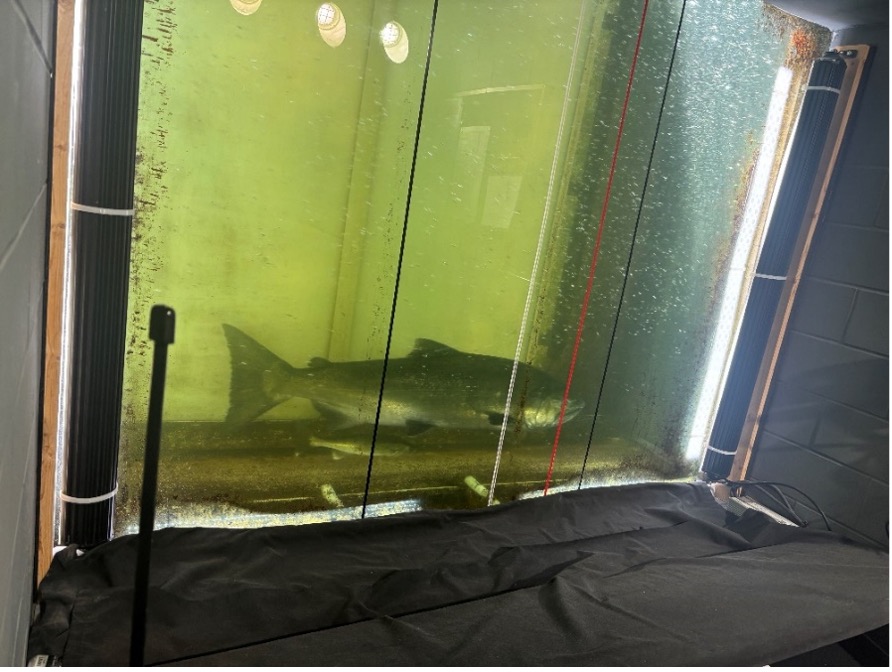
Giant chinook salmon in fish ladder at Lower Granite Dam
Working with the Nez Perce Tribe
During my time I got to work with some brilliant people from the Nez Perce Tribe and got to go on some awesome trips with them. One of my most memorable experiences was when I helped work up lamprey eels to be released at the tribal hatchery on Cherry Lane. During that I was able to handle the eels and get fin clippings. It was super fun trying to handle the eels and be apart of the organized chaos.
Furthermore, a place that was unforgettable was Musselshell Meadows. In the short time of my internship, I got to see a log jam removal, removal of fish via electroshocking for bridge construction, and the beginning stages of beaver dam analogues getting put in. Also, on one of the drives up there I saw my first Idaho moose and her calves!
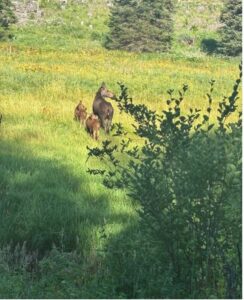
The moose and her calves
Although those are my favorite trips, I also got to go on the Lewiston Orchards Irrigation district tour, survey juvenile salmon and steelhead, do a tour of Wallowa Lake, and survey for PIT tags.
Final thoughts
My time with TU this summer has been nothing short of unforgettable, from the stunning wildlife and nature to the amazing coworkers and worksites. In this short time, I’ve learned so much about what conservation looks like by seeing streams get restored, the data collection needed to make it so people can go out in the field and do projects, and hatcheries keeping the populations up. Although this must unfortunately come to an end, I am now going to be able to go into the rest of my life with many great lessons and memories.